
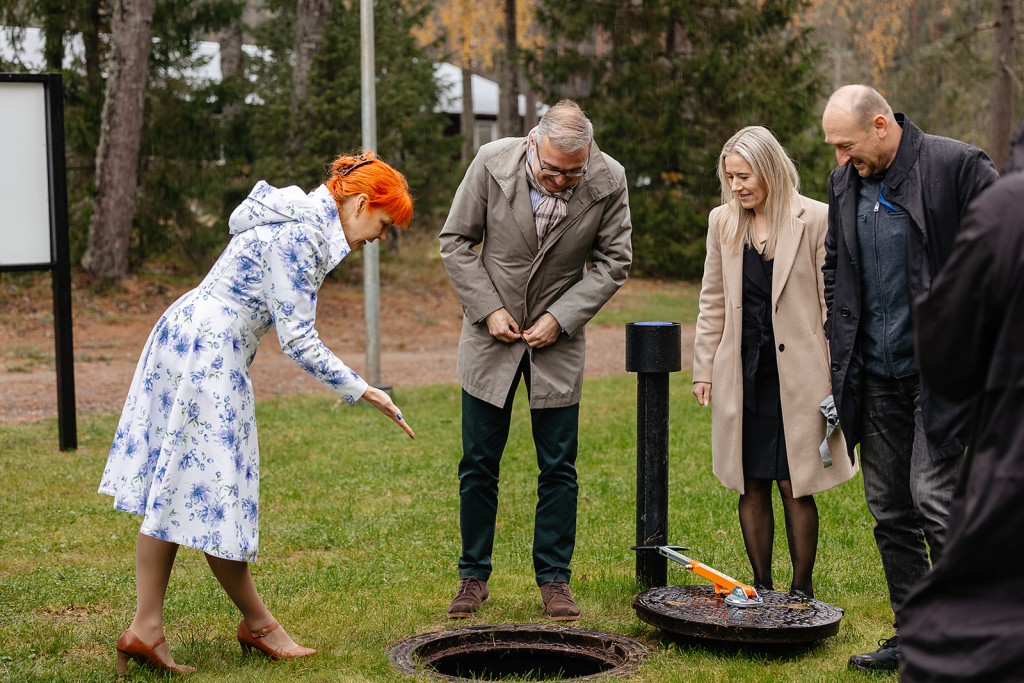
Minister of Energy and the Environment Andres Sutt emphasized the importance of innovation in clean energy: “New sources of clean energy are always welcome. In heating solutions, Finland and Sweden have been pioneers whose experience is worth learning from. While Estonia’s subsurface is not as hot as Iceland’s, we need aswell new knowledge, skills and experiments. We have some advantages of our own - for instance, the absence of earthquakes. And generating 40 kW of green energy under any weather conditions is already a strong argument showing that geothermal energy has real potential here,” Sutt noted.
The key technological innovation of the Arbavere test site is a coaxial borehole heat exchanger, where groundwater flows upward through the inner pipe, transfers its heat via a heat exchanger, and then returns underground through the outerside of coaxial collector and extracting the geothermal energy from the surrounding rocks.
According to Helena Gailan, Head of the Department of Geothermal Energy at EGT, the Arbavere site marks a significant step toward the application of deep geothermal energy in Estonia: “The use of coaxial borehole heat exchanger technology is a first for Estonia. It allows us to assess the system’s reliability and energy efficiency in our local geological conditions. The test site provides us with valuable insights that will support the broader use of geothermal energy in the country,” said Gailan.
Unlike conventional ground-source heat systems that use a closed-loop of plastic pipes filled with heat transfer fluid, the Arbavere borehole circulates groundwater continuously within a closed system. This makes the technology more environmentally friendly and more energy-efficient, as the losses of heat transfer are smaller. The use of deep boreholes also enables the generation of sufficient heat with fewer wells - an important advantage in densely built areas where is lack of available surface land area that is required for the common horizontal loops or shallow borehole fields.
After drilling, the water temperature was measured 20 °C, which is considered excellent for Estonian geological conditions. The borehole has a designed to extract geothermal energy of 40 kW. Three ground-source heat pumps have been installed for heating, and one building is equipped also with a cooling system.
The project has a novel 5G-enabled technology with a low-temperature district heating and cooling network with an automated control system to manage the heating and cooling needs of the EGT research facility and core sample storage buildings, serving approximately 1,000 m² of total floor space. The total project cost amounts to €1.1 million (plus VAT), which around 60% was allocated to drilling and 35% to the installation of heat pumps, pipelines, and automation systems. The drilling was carried out by OÜ Inseneribüroo Steiger in cooperation with the Finnish company QHEAT, while Coron OÜ, AindPRO, and K&S Torutööd were responsible for the district heating network and heat pump installations together with automation works.
The use of geothermal energy solutions in Estonia has grown rapidly in recent years - in 2024 alone, more than 1,500 new geothermal boreholes were drilled. According to EGT, geothermal energy is one of the key technologies for ensuring Estonia’s future energy independence from fossil fuels.
“Together with improving building energy efficiency and upgrading heating systems, the use of geothermal energy offers a real opportunity to reduce both energy consumption and costs,” added Gailan.

